
“Racism is the most challenging issue confronting America. To ignore the problem is to expose the country to physical, moral, and spiritual danger.” –National Spiritual Assembly of the Bahá’ís of the US
As a white woman, I have several strong relationships with people of different colors. I feel honored when an African American friend shares with me the pain and obstacles of their daily life. Trust means acceptance. People of color are often confronted with whites naively thinking and saying things like, “Oh, it can’t be THAT bad.” I view my friendships with African Americans as priceless.
I’m fortunate to be a Bahá’í, where racism is confronted head on—and not ignored. I get excited when I see the younger Bahá’í generation genuinely free from old tendencies and actively working to eradicate the disease of racism. I envy their ease and the fullness of their friendships. It also fills my heart with hope that we can go beyond racism—to race unity.
The Bahá’í Faith is about building new relationships. It starts with a sincere look at the past—as well as the present.
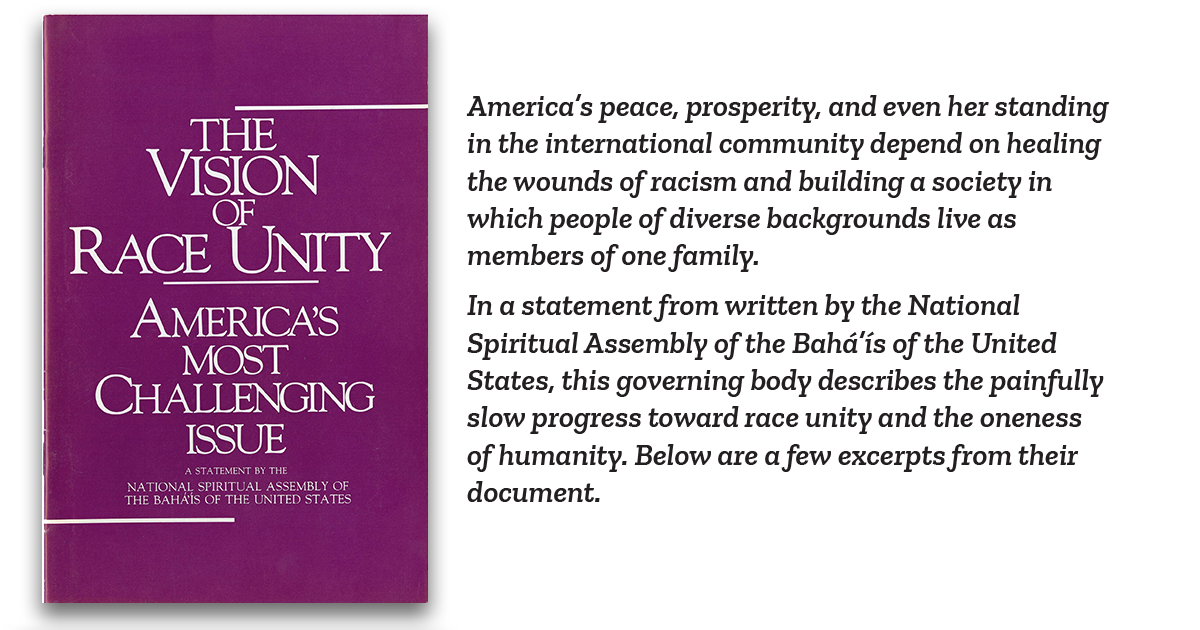
Click on the link to read the full brochure, “The Vision of Race Unity, America’s Most Challenging Issue”.
Racism Runs Deep
“Racism runs deep. It infects the hearts of both White and Black Americans. Since _without conscious, deliberate, and sustained effort, no one can remain unaffected by its corrosive influence, both groups must realize that such a problem can neither easily nor immediately be resolved. ‘Let neither think that anything short of genuine love, extreme patience, true humility, consummate tact, sound initiative, mature wisdom, and deliberate, persistent, and prayerful effort can succeed in blotting out the stain which this patent _evil has left on the fair name of their common country.”
Race, Friendships and Racial Equality
“Diversity of color, nationality, and culture enhances the human experience and should never be made a barrier to harmonious relationships, to friendship, or to marriage. “O well-beloved ones!” Bahá’u’lláh wrote. “The tabernacle of unity has been raised; regard ye not one another as strangers. Ye are the fruits of one tree and leaves of one branch.”
“A nation whose ancestry includes every people on earth, whose motto is E pluribus unum, whose ideals of freedom under law have inspired millions throughout the world, cannot continue to harbor prejudice against any racial or ethnic group without betraying itself. Racism is an affront to human dignity, a cause of hatred and division, a disease that devastates society.
Notwithstanding the efforts already expended for its elimination, racism continues to work its evil upon this nation. Progress toward tolerance, mutual respect, and unity has been painfully slow and marked with repeated setbacks. The recent resurgence of divisive racial attitudes, the increased number of racial incidents, and the deepening despair of minorities and the poor make the need for solutions ever more pressing and urgent. To ignore the problem is to expose the country to physical, moral and spiritual danger.
Aware of the magnitude and the urgency of the issue, we, the National Spiritual Assembly of the Bahá’ís of the United States, speaking for the entire U.S. Bahá’í community, appeal to all people of goodwill to arise without further delay to resolve the fundamental social problem of this country. We do so because of our feeling of shared responsibility, because of the global experience of the Bahá’í community in effecting racial harmony within itself, and because of the vision that the sacred scriptures of our Faith convey of the destiny of America.
“Both groups must understand that no real change will come about without close association, fellowship, and friendship among diverse people.”
The oneness of humanity is the pivot round which revolve all the teachings of the Bahá’í Faith. It is at once a statement of principle and an assertion of the ultimate goal of human experience on the planet. More than a century ago Bahá’u’lláh, the Prophet-Founder of the Bahá’í Faith, wrote: “The well-being of mankind, its peace and security, are unattainable unless and until its unity is firmly established.” It is a principle that issues naturally from the genesis and purpose of human existence. The Word of God as presented in the Bahá’í writings offers compelling insights as in the following examples:
Veiled in My immemorial being and in the ancient eternity of My essence, I knew My love for thee; therefore I created thee, have engraved on thee Mine image and revealed to thee My beauty.
Know ye not why We created you all from the same dust? That no one should exalt himself over the other. Ponder at all times in your hearts how ye were created. Since We have created you all from the same substance it is incumbent on you to be even as one soul, to walk with the same feet, eat with the same mouth and dwell in the same land, that from your inmost being, by your deeds and actions, the signs of oneness and the essence of detachment may be made manifest. Such is My counsel to you, O concourse of light! Heed ye this counsel that ye may obtain the fruit of holiness from the tree of wondrous glory.
All men have been created to carry forward an ever-advancing civilization. The Almighty beareth Me witness: To act like the beasts of the field is unworthy of man. Those virtues that befit his dignity are forbearance, mercy, compassion and loving-kindness towards all the peoples and kindreds of the earth.
Having gone through the stages of infancy and turbulent adolescence, humanity is now approaching maturity, a stage that will witness “the reconstruction and demilitarization of the whole civilized world a world organically unified in all the essential aspects of its life.” In no other country is the promise of organic unity more immediately demonstrable than in the United States because this country is a microcosm of the diverse populations of the earth. Yet this promise remains largely unrealized even here because of the endemic racism that, like a cancer, is corroding the vitals of the nation.
For too much of its history and in so many places the human race has squandered its energy and resources in futile efforts to prove the unprovable: that one portion of itself, because of separation by geography, a difference in skin color, or the diversity of cultural expression, is intrinsically distinct from another portion. The ignorance and prejudice on which such efforts are founded have led to endless conflicts in the name of the sanctity of tribe, race, class, nation, religion. Paradoxical as it may seem, in the consistency of these negative efforts across the spectrum of the race, humanity has proved the exact opposite: it has affirmed its oneness. The proof is in the fact that, given the same circumstances, all people, regardless of ethnic or cultural variety, behave essentially the same way. In the futility of its efforts to classify and separate its diverse elements, humanity has become disoriented and confused. Unaided by the divine influence of religion, people are incapable of achieving a proper orientation to their innermost reality and purpose and are thus unable to achieve a coherent vision of their destiny. It is in this respect that the Bahá’ís find relevancy, direction, and fulfillment in the teachings of Bahá’u’lláh, the Founder of their Faith.
The oneness of humanity is a spiritual truth abundantly confirmed by science. Recognition of this truth compels the abandonment of all prejudices of race, color, creed, nation, and class–of “everything which enables people to consider themselves superior to others. ”The principle of the oneness of humankind “is no mere outburst of ignorant emotionalism or an expression of vague and pious hope…. It does not constitute merely the enunciation of an ideal…. It implies and organic change in the structure of present-day society, a change such as the world has not yet experienced.”
“The application of the spiritual principle of the oneness of humanity to the life of the nation would necessitate and make possible vast changes in the economic status of the non-white segments of the population. Although poverty afflicts members of all races, its victims tend to be largely people of color. Prejudice and discrimination have created a disparity in standards of living, providing some with excessive economic advantage while denying others the bare necessities for leading healthy and dignified lives. Poor housing, deficient diet, inadequate health care, insufficient education are consequences of poverty that afflict African Americans, American Indians, and Hispanic Americans more than they afflict the rest of the population. The cost to society at large is heavy.
Evidence of the negative effect of racial and ethnic conflict on the economy has prompted a number of businesses and corporations to institute educational programs that teach conflict resolution and are designed to eliminate racial and ethnic tensions from the workplace. These are important steps and should be encouraged. If, however, they are intended primarily to save the economy, no enduring solution will be found to the disastrous consequences of racism. For it cannot suffice to offer academic education and jobs to people while at the same time shutting them out because of racial prejudice from normal social intercourse based on brotherly love and mutual respect. The fundamental solution–the one that will reduce violence, regenerate and focus the intellectual and moral energy of minorities, and make them partners in the construction of a progressive society–rests ultimately on the common recognition of the oneness of humankind.
It is entirely human to fail if that which is most important to people’s self-perception is denied them–namely, the dignity they derive from a genuine regard by others for their stature as human beings. No educational, economic, or political plan can take the place of this essential human need; it is not a need that businesses and schools, or even governments, can provide in isolation from the supportive attitude of society as a whole. Such an attitude needs to be grounded in a spiritual and moral truth that all acknowledge and accept as their own and that, like the oxygen that serves all equally, breathes life into their common effort to live in unity and peace. Absence of the genuine regard for others fostered by such truth causes hopelessness in those discriminated against; and in a state of hopelessness, people lose the coherent moral powers to realize their potential. This vitalizing truth, we are convinced, is summarized in the phrase: the oneness of humankind.
So essential is the principle of the oneness of humanity to the efficacy of educational programs that it cannot be overemphasized. Without its broad influence such programs will not contribute significantly to the development of society. The very fact that businesses are themselves implementing educational programs is indicative of the glaring deficiency of the entire educational system. As we have already said, beyond the mechanisms of education lies the essential prerequisite of a proper attitude on the part of those dispensing curricula and, even more important, on the part of society as a whole.
On this basis, education is not only the shortest route out of poverty; it is the shortest route out of prejudice as well. A national program of education, emphasizing the values of tolerance, brotherhood, appreciation for cultures other than one’s own, and respect for differences would be a most important step toward the elimination of racism and, as a consequence, the bolstering of the economy.” —The Vision of Race Unity, National Spiritual Assembly of the United States.
By Susan Peterson, member of the Highland Park Baha’i community | January, 2024
© 2023 – 2025, Susan Peterson, All Rights Reserved.